
A household goods carrier recently walked into arbitration expecting its 60¢-per-pound liability limitation to hold.
It walked out owing $10,330.
Not because the arbitrator, who is the determining authority, found bad faith. Not because the carrier didn’t move the shipment. And not because the customer hadn’t signed the Released Value waiver.
The problem was much more common than we like to think.
A couple of very familiar paperwork shortcuts came back with a very unfamiliar price tag.
And before anyone says, “Well, WE would never…”
Come on.
Who hasn’t had a pickup where the customer suddenly has another 40 items? The crew is waiting. You’re already late for the next job. Nobody has had coffee. Someone says, “Just update the estimate and let’s get moving.”
And that little voice whispering “we’ll finish the paperwork properly later”?
That little guy just cost someone ten grand.
Shortcut #1: “They Signed the 60¢ Option. We’re Good.”
Narrator: They were not good.
The customer had initialed and signed the Released Value waiver. But the carrier left one critical piece blank: the total cost of the move with Full Value Protection.
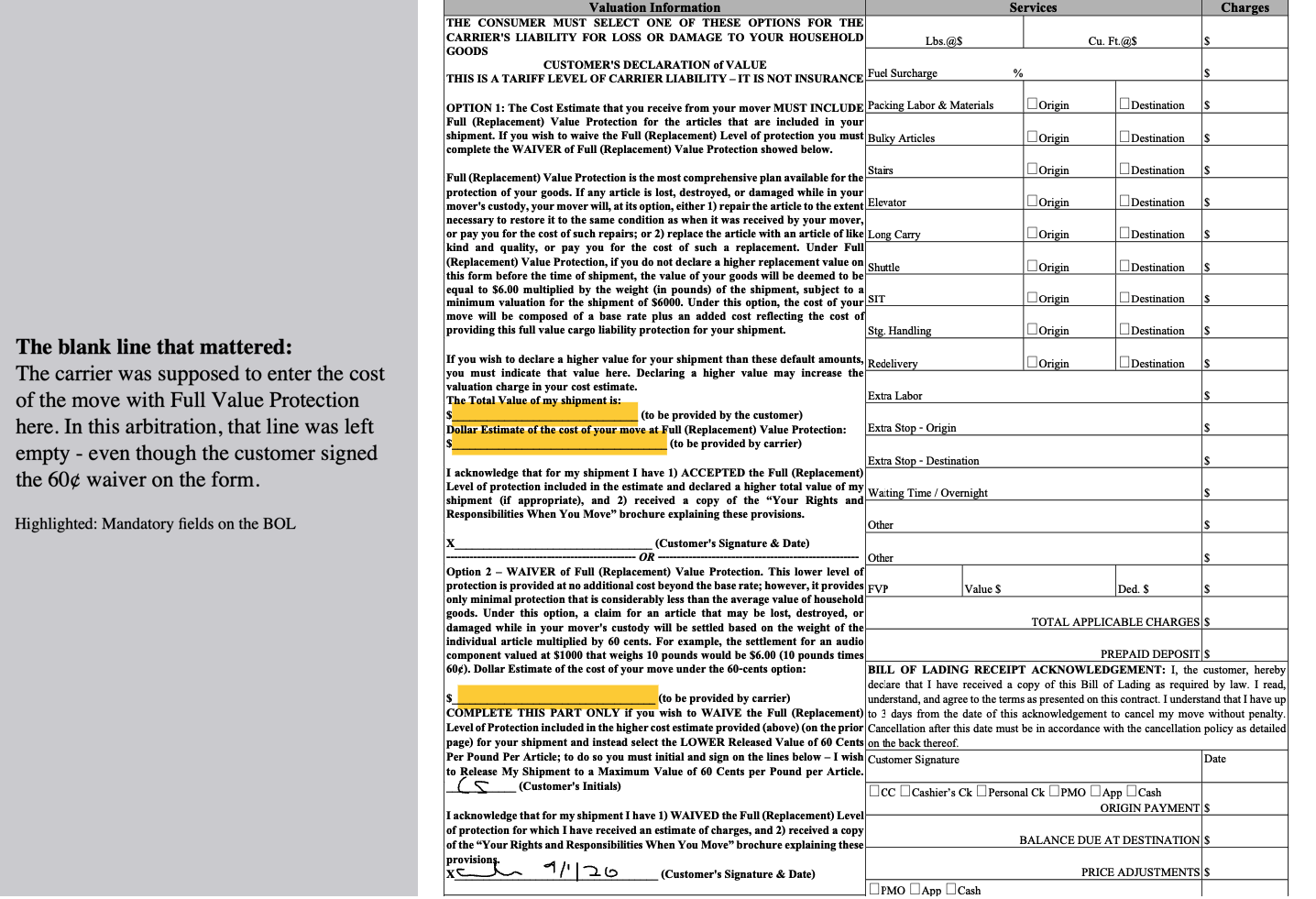
That’s a field plenty of carriers may be tempted to skip. The customer chose 60¢. They signed. Everyone understands what they picked. Next page, please.
Except federal compliance wants the customer to to make an informed decision about their valuation options and understand the price difference between the liability options. In this arbitration, without an FVP price, the arbitrator found that the carrier had not established that meaningful choice — and the 60¢ limitation could not be enforced.
Lesson: The signature isn’t the whole process.
Give the customer the FVP price. Complete all the required information in both valuation sections. Then get the customer’s signature.
It’s one more detail in a long list of things that have to go right on moving day — but this one is worth double-checking.
Shortcut #2: “There’s More Stuff. Just Update the Price.”
Ah, pickup day.
The magical day when a 2,700-cubic-foot estimate can meet the customer’s “Oh, and we’re taking all of this too.”
The carrier in this case really did receive substantially more goods than originally estimated. The arbitrator acknowledged that. But the new estimate increased the volume and price without listing the additional goods in detail, and the form didn’t indicate whether the new estimate was binding or non-binding.
That’s an important second lesson:
More stuff can justify a new estimate. “More stuff” is not a new estimate.
When the shipment changes, document what was added and complete the required estimate properly before loading.
Your crew may be in a hurry.
Federal regulations are famously unconcerned with your next pickup.
The $10,000 Moral of the Story
What makes this case especially worth learning from is what the determining authority said at the end.
There was no finding of bad faith. The arbitrator accepted that considerably more goods had been moved.
But the required paperwork steps weren’t completed.
In the arbitrator’s words:
“The lines left blank on Respondent’s forms decided this case.”
That’s the lesson worth sticking above the dispatcher’s coffee machine:
Don’t just have the right forms. Complete them.
Because sometimes the most expensive item on the truck…
is the blank you forgot to fill in.
Want to make sure your team knows how to stay compliant when it matters most? CSI offers compliance training for Operations, Customer Service, and Sales teams, helping your staff understand the requirements and apply them in real-world moving situations. Because “we’ve always done it this way” is surprisingly hard to fit into the compliance section of a Bill of Lading 😉 For more information or to schedule training, contact Harry at (772) 204-0644 or Sales@csipros.org.